Eastward is harder. Performance pays.
A 2017 paper in Medicine & Science in Sports & Exercise studied team-sport athletes flying eastward versus westward and found eastward travel produced significantly worse subjective jet lag and measurable decrements in team-sport performance [1]. The biological reason is straightforward. The human circadian system has a slight intrinsic period longer than 24 hours, so phase-delaying (westward) is biologically easier than phase-advancing (eastward).
The Clinical Journal of Sport Medicine has published practical management frameworks built around this asymmetry. They prioritize pre-flight light scheduling, sleep banking, in-flight hydration, and adjusting meal timing to the destination [2]. A 2019 Frontiers in Physiology review synthesized the intervention evidence specifically for athletes [3].
Light, behavior, and recovery sleep, in that order
Light is the strongest zeitgeber. Bright light exposure timed correctly relative to your destination is the single most effective entrainment lever. Behavioral interventions (meal timing, exercise timing, social schedule) are second. Pharmacological interventions, including melatonin, are third in most evidence-based frameworks.
What every framework agrees on is that the quality of the recovery sleep you do get during travel matters disproportionately. A short fragmented night in a hotel room costs more in performance terms than a short night at home, because circadian misalignment compounds with sleep loss.
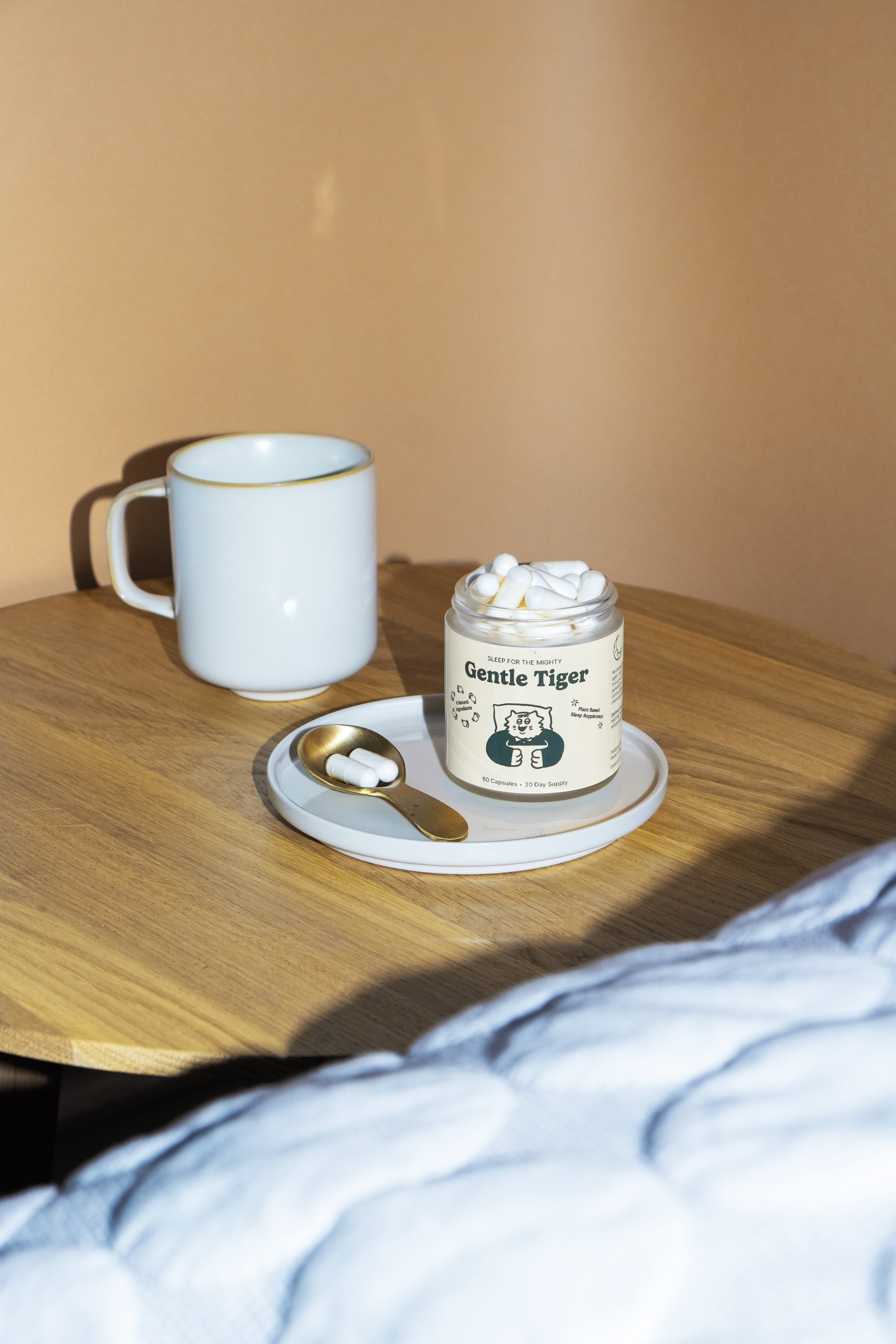
Gentle Tiger supports the GABA, serotonergic, and cortisol-modulating pathways that govern sleep depth. The architecture layer that travel chaos squeezes hardest. Circadian phase-shifting is a different job, handled by light scheduling and timed low-dose melatonin.
You can't always get more sleep on the road. You can sometimes get deeper sleep.
How most of our athletes use it for travel
For pre-race travel, the highest-leverage moves are: shift bedtime gradually toward the destination time zone for 3 to 5 nights pre-flight, expose yourself to morning light at your destination for the first 2 to 3 days, and protect sleep duration aggressively in the hotel room. Gentle Tiger fits as the nightly recovery sleep support: same dose, same timing, regardless of time zone.
For occasional one-off jet lag, low-dose melatonin (0.3 to 1 mg) timed correctly has reasonable evidence and remains in most sport-medicine recommendations. Gentle Tiger and low-dose melatonin can in principle be used at different stages of a travel protocol. We recommend not stacking nightly sleep aids without consulting your physician.
- Shift bedtime 30 to 60 minutes per day toward destination for 3 to 5 days before travel
- Get morning sunlight at the destination for 2 to 3 days post-arrival
- Hydrate aggressively in-flight; minimize alcohol and caffeine
- Gentle Tiger: 2 capsules, 30 to 60 minutes before bed, regardless of time zone
- For severe eastward jet lag, discuss timed low-dose melatonin protocols with a sport-medicine physician
Common questions
Is Gentle Tiger a jet-lag treatment?
No. Jet lag is a circadian timing problem, and the most effective interventions are light scheduling and behavioral entrainment. Gentle Tiger is a sleep architecture supplement. It supports the depth and quality of whatever sleep you do get, which matters more than usual when circadian alignment is off.
Can I take it on the plane?
We recommend taking it 30 to 60 minutes before your intended sleep period. On a long-haul flight, that means timing it to your destination's bedtime if you're attempting to pre-shift. Many athletes prefer to take it for the first nights at the destination rather than in-flight.
Should I combine it with melatonin for jet lag?
We don't recommend stacking sleep aids without physician guidance. Low-dose timed melatonin (0.3 to 1 mg) has reasonable evidence for jet lag specifically. Gentle Tiger is built for nightly recovery sleep. If you're using both, it's worth a conversation with a sport-medicine physician about timing.
What about race-week travel?
Race-week travel is one of the highest-stakes sleep windows in an athletic year. Stick to your normal Gentle Tiger dose, prioritize sleep duration and environment, and start light-based circadian entrainment 3 to 5 nights before you fly. The cumulative recovery sleep across the week before a race usually matters more than the night-before specifically.
Peer-reviewed sources
Every claim on this page is backed by a PubMed-indexed study.
- [1]Fowler PM, Knez W, Crowcroft S, et al. (2017). “Greater Effect of East versus West Travel on Jet Lag, Sleep, and Team Sport Performance.” Medicine & Science in Sports & Exercise · PMID: 28628042
- [2]Samuels CH (2012). “Jet lag and travel fatigue: a comprehensive management plan for sport medicine physicians and high-performance support teams.” Clinical Journal of Sport Medicine · PMID: 22637076
- [3]Roach GD, Sargent C (2019). “Interventions to Minimize Jet Lag After Westward and Eastward Flight.” Frontiers in Physiology · PMID: 31417425
- [4]Eom et al. (2022). “Jujube fruit extract promotes sleep through GABA-mediated mechanisms.” Journal of Ethnopharmacology
- [5]Zhang et al. (2018). “Schisandra chinensis produces anxiolytic effects and reduces sleep latency.” Phytomedicine
Sleep through training blocks
What the IOC consensus statement says about athlete sleep, and how to protect it.
Read →The full recovery stack
How sleep stacks with protein, hydration, and cold therapy.
Read →Trade your melatonin for six plants
Why supraphysiologic melatonin is the wrong tool for nightly recovery sleep.
Read →Stop dragging through morning training
Sleep gentle tonight. Train with a roar tomorrow.
Recovery Capsules
$44.0060 capsules · 30-day supply · 2 per night