GLP-1 weight loss measurably improves sleep apnea
The 2024 New England Journal of Medicine SURMOUNT-OSA trial randomized adults with obesity and moderate-to-severe obstructive sleep apnea to tirzepatide or placebo. Across 52 weeks, the apnea-hypopnea index (the standard measure of sleep-disordered breathing) fell by approximately 25 to 29 events per hour more in the tirzepatide arm [1].
That's a meaningful clinical effect. OSA is a major driver of fragmented sleep, daytime fatigue, and cardiovascular risk. Earlier work with liraglutide in the SCALE Sleep Apnea trial showed similar directional benefits [4].
The story is straightforward. Weight loss reduces upper-airway collapsibility, which reduces apneic events, which improves sleep continuity. GLP-1 medications drive weight loss [2][3]. The sleep apnea benefit is downstream.
Sleep architecture during a major metabolic transition
Reducing apneic events is one piece of sleep recovery. The other piece is the time you spend in deep sleep and REM, where your body rebuilds. That layer is governed by GABAergic, serotonergic, and HPA-axis systems that GLP-1 medications don't directly target.
Calorie deficit, even a medication-driven one, can also affect sleep quality. Hunger cues, GI side effects from the medication, and the physiologic stress of rapid weight loss can all fragment sleep. The published data on sleep restriction during a deficit is striking. A 2010 Annals of Internal Medicine RCT found that restricting sleep to 5.5 hours a night during weight loss cut fat loss by 55% and increased lean-mass loss by 60%, compared to 8.5 hours of sleep with the same caloric intake [5].
The translation: when you're on a GLP-1 medication trying to optimize body composition, the quality of your sleep is one of the largest non-medication levers on the outcome.
GLP-1 changes the metabolic landscape. Sleep determines what your body does with the change.
A plant-based sleep formula, not a GLP-1 adjunct
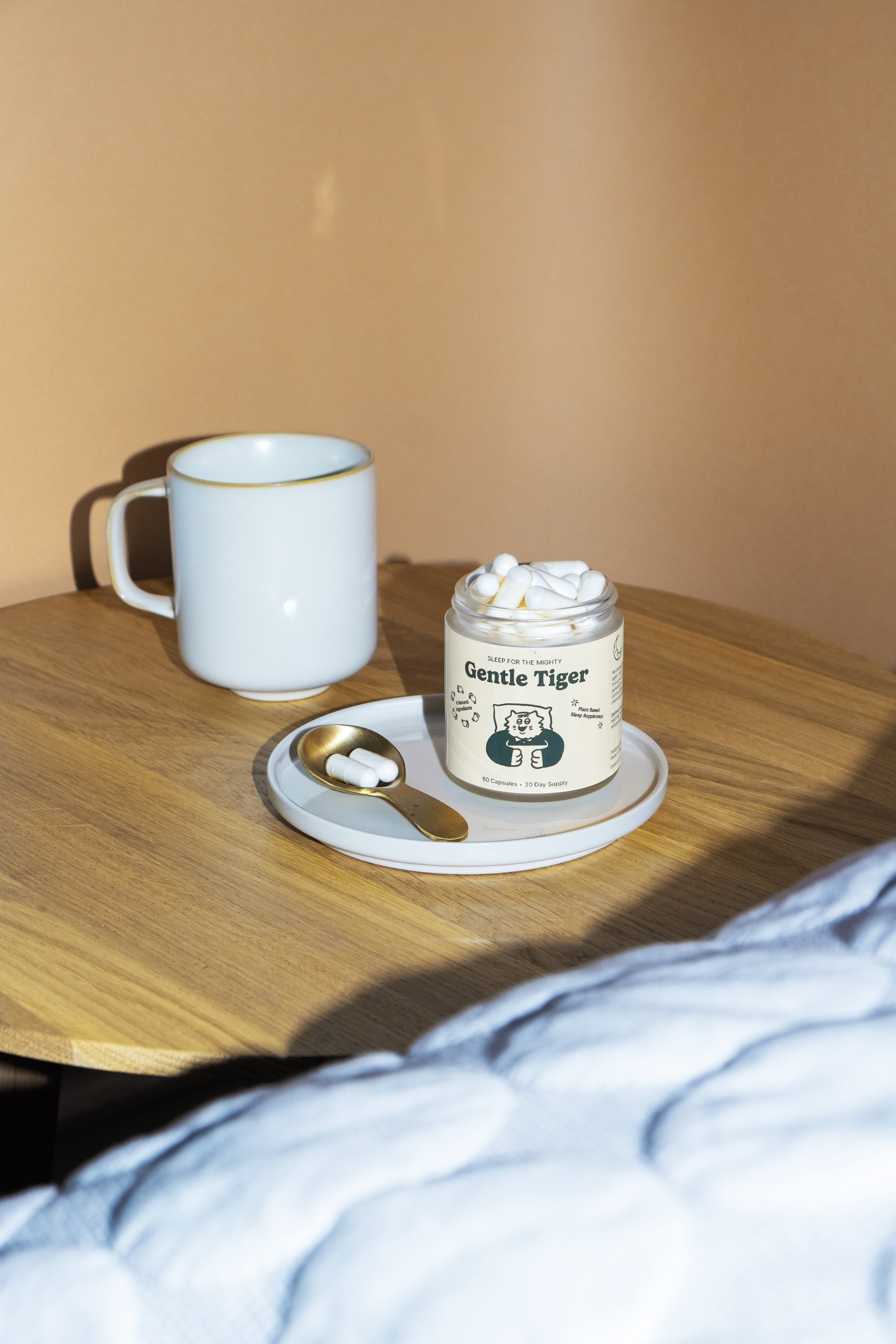
Gentle Tiger is a sleep recovery supplement. It does not act on GLP-1 receptors and does not modulate the metabolic pathways semaglutide and tirzepatide work on. Six plants designed to extend deep sleep and REM through GABA, serotonergic, and cortisol-modulating pathways.
We're including this page because a meaningful share of our customers are on GLP-1 medications and ask whether the two can be taken together. The plain answer: there are no known negative interactions between standard prescription GLP-1 medications and the six plants in our formula. You should still consult your physician before adding any supplement to a prescription protocol.
If you're on a GLP-1, your sleep quality matters more than usual. Both for the body composition outcome and for managing the side-effect profile during the months your body is adapting.
- Six plant compounds, no melatonin, no cannabinoids, no synthetic sedatives
- No known interaction with semaglutide or tirzepatide
- Not a GLP-1 adjunct or weight-loss supplement
- Consult your physician before combining supplements with prescription medication
Common questions
Can I take Gentle Tiger if I'm on Ozempic, Wegovy, or Mounjaro?
There are no known negative interactions between standard-dose semaglutide or tirzepatide and the six plants in Gentle Tiger. We strongly recommend consulting your prescribing physician before adding any supplement to a prescription protocol. They know your full medical picture, and any sleep aid is something they should sign off on.
Does Gentle Tiger help with GLP-1 side effects?
We don't make that claim. Common GLP-1 side effects (nausea, GI upset, fatigue) aren't what Gentle Tiger is formulated for. What we can say is that sleep quality matters during any major metabolic transition, and the plants in our formula are designed to extend deep sleep and REM. Anything beyond that is a conversation for your physician.
Will it affect my weight loss?
Gentle Tiger is not a weight-loss supplement and we don't claim it affects weight loss directly. The peer-reviewed evidence on sleep and body composition is clear. Sleep restriction during a calorie deficit blunts fat loss and increases lean-mass loss [5]. If supporting deeper sleep helps you sleep your full prescribed hours during a GLP-1 protocol, that may indirectly support the body composition outcome. The weight loss itself is your medication's job.
When should I take it relative to my GLP-1 dose?
Gentle Tiger is taken 30 to 60 minutes before bed regardless of when your GLP-1 dose is. There's no known timing interaction. Your physician is the right person to confirm this for your specific protocol.
Peer-reviewed sources
Every claim on this page is backed by a PubMed-indexed study.
- [1]Malhotra A, Grunstein RR, Fietze I, et al. (2024). “Tirzepatide for the Treatment of Obstructive Sleep Apnea and Obesity.” New England Journal of Medicine · PMID: 38912654
- [2]Wilding JPH, Batterham RL, Calanna S, et al. (2021). “Once-Weekly Semaglutide in Adults with Overweight or Obesity (STEP 1).” New England Journal of Medicine · PMID: 33567185
- [3]Jastreboff AM, Aronne LJ, Ahmad NN, et al. (2022). “Tirzepatide Once Weekly for the Treatment of Obesity (SURMOUNT-1).” New England Journal of Medicine · PMID: 35658024
- [4]Blackman A, Foster GD, Zammit G, et al. (2016). “Effect of liraglutide 3.0 mg in individuals with obesity and moderate or severe obstructive sleep apnea.” International Journal of Obesity · PMID: 27034105
- [5]Nedeltcheva AV, Kilkus JM, Imperial J, Schoeller DA, Penev PD (2010). “Insufficient sleep undermines dietary efforts to reduce adiposity.” Annals of Internal Medicine · PMID: 20921542
Sleep through training blocks
What the IOC consensus statement says about athlete sleep, and how to protect it.
Read →The full recovery stack
How sleep stacks with protein, hydration, and cold therapy.
Read →Trade your melatonin for six plants
Why supraphysiologic melatonin is the wrong tool for nightly recovery sleep.
Read →Stop dragging through morning training
Sleep gentle tonight. Train with a roar tomorrow.
Recovery Capsules
$44.0060 capsules · 30-day supply · 2 per night