Each herb does one thing, modestly
Valerian has the longest sleep history of any popular Western herb. The 2020 systematic review and meta-analysis in the Journal of Evidence-Based Integrative Medicine found consistent subjective sleep improvement, but objective polysomnography findings were mixed [1]. A 2010 review reached similar conclusions [2].
Chamomile's apigenin binds to GABA receptors. Real mechanism, well-documented [3]. A 2016 RCT in postnatal women with sleep disturbance showed measurable subjective improvement from chamomile tea [4]. Effect size is modest.
Lavender (specifically the Silexan preparation) showed efficacy for subsyndromal anxiety in 2010, with sleep improvement as a downstream effect [5]. Ashwagandha lowers cortisol and improves subjective sleep onset in a 2019 RCT [6], though the adaptogenic profile leaves some users feeling stimulated rather than calmer.
Each of these herbs has real evidence behind it. None of them, on their own, covers everything sleep needs.
Sleep has multiple control loops
Sleep depth, sleep onset, sleep continuity, and morning recovery are governed by overlapping biological systems. GABAergic. Serotonergic. The HPA axis that runs cortisol. Circadian signaling. A single-herb supplement pulls one lever well. A multi-herb formula chosen for complementary mechanism can pull several at once, at lower individual doses.
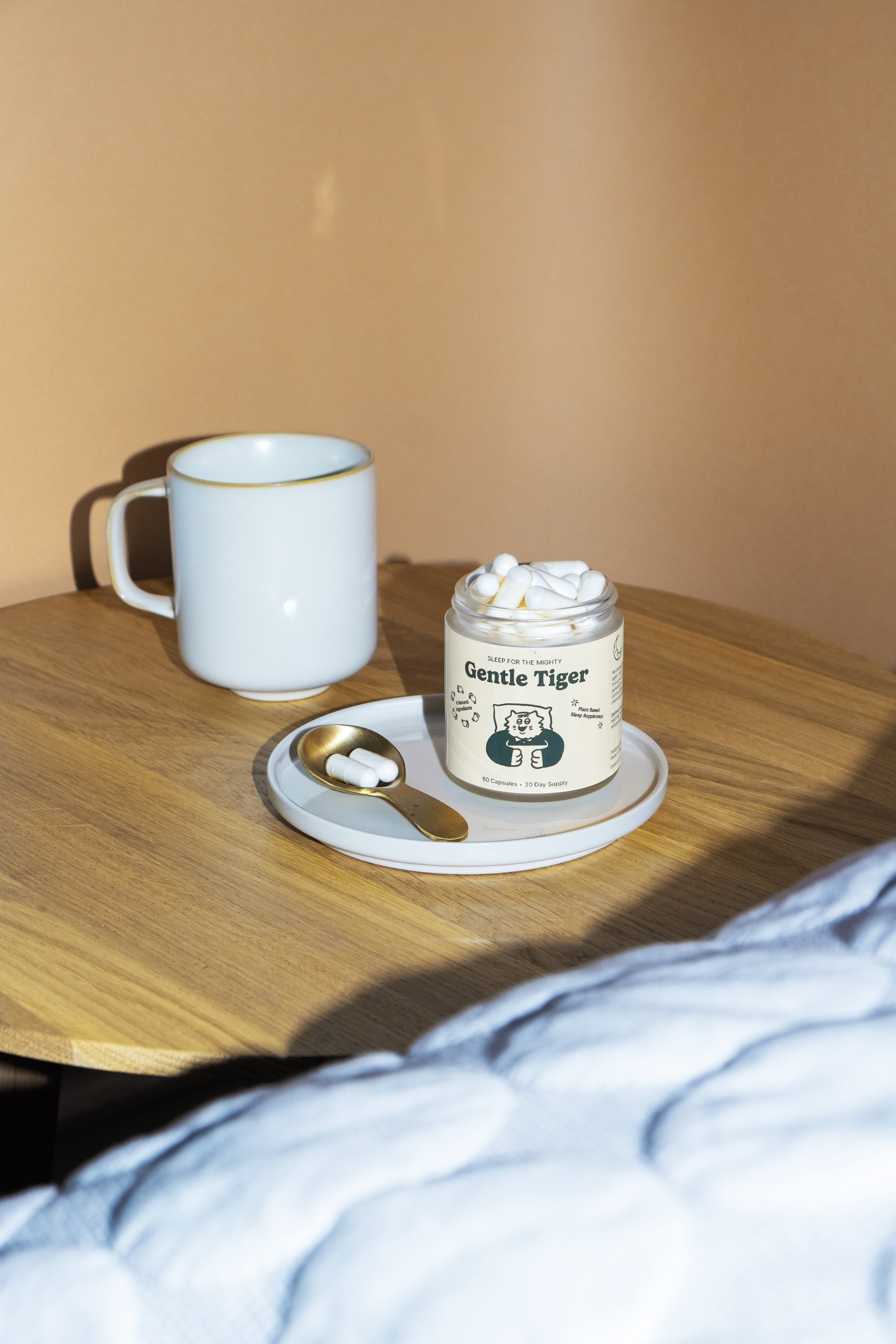
We picked the six plants in Gentle Tiger for that complementarity. Spine date seed and red date for GABA-mediated sleep promotion [9]. Poria Cocos for REM and deep sleep extension [8]. Magnolia Fruit for anxiolytic action and faster sleep latency [10]. Tart Cherry for natural melatonin precursors and inflammation reduction [11]. Atractylodes for nervous system modulation [12].
The formula acts on the architecture of sleep: depth, duration, recovery quality. None of which a single herb covers on its own.
And why the trends didn't make the cut
We made deliberate exclusions. No melatonin. Synthetic hormone, supraphysiologic dosing, working against the recovery sleep we wanted to build for. No CBD. The labeling problems and athlete drug-testing risk make it a poor fit for nightly use. No valerian. The sedative profile and morning grogginess work against the sharp-mornings positioning we wanted.
No reishi. No lion's mane. No ashwagandha. These plants have legitimate uses in adaptogens, focus, and immune modulation. The peer-reviewed evidence for them as sleep architecture extenders is thinner than the marketing suggests. We kept the formula focused on plants whose sleep mechanism shows up in primary literature.
Six plants. Six mechanisms. Each one earned its spot.
- Spine Date Seed: GABA and serotonin pathway, cortisol reduction [7]
- Poria Cocos: REM and deep sleep extension [8]
- Red Date: GABA-mediated sleep promotion [9]
- Magnolia Fruit: anxiolytic and faster sleep latency [10]
- Tart Cherry: melatonin precursors and anti-inflammatory [11]
- Atractylodes: nervous system modulation [12]
Common questions
Why not just take valerian?
Valerian has decent subjective sleep evidence but mixed objective findings, and many users report a sedative profile with next-day grogginess [1]. We wanted a formula athletes could take nightly without that morning trade-off. Cleaner-mechanism plants, multi-pathway design, no morning fog.
Is chamomile in the formula?
It's not. Chamomile's apigenin/GABA mechanism is real [3], but Spine Date Seed and Red Date hit the same GABA pathway more potently at the doses we use. Same target, stronger lever.
Why not ashwagandha?
Ashwagandha lowers cortisol and improves sleep onset for many people [6]. We didn't include it because Spine Date Seed and Magnolia Fruit handle cortisol modulation in our formula, and ashwagandha has an adaptogenic profile that some users experience as stimulating. Different design choice for the same end goal.
Can I stack Gentle Tiger with my existing herbal supplements?
Generally yes. There are no known negative interactions between the six plants in Gentle Tiger and standard herbal sleep supplements. We recommend not stacking multiple sedating herbs at once, and consulting your physician if you're on prescription medication.
Peer-reviewed sources
Every claim on this page is backed by a PubMed-indexed study.
- [1]Shinjyo N, Waddell G, Green J (2020). “Valerian Root in Treating Sleep Problems and Associated Disorders — A Systematic Review and Meta-Analysis.” Journal of Evidence-Based Integrative Medicine · PMID: 33086877
- [2]Salter S, Brownie S (2010). “Treating primary insomnia — the efficacy of valerian and hops.” Australian Family Physician · PMID: 21301676
- [3]Srivastava JK, Shankar E, Gupta S (2010). “Chamomile: A herbal medicine of the past with bright future.” Molecular Medicine Reports · PMID: 21132119
- [4]Chang SM, Chen CH (2016). “Effects of an intervention with drinking chamomile tea on sleep quality and depression in sleep disturbed postnatal women.” Journal of Advanced Nursing · PMID: 26483209
- [5]Kasper S, Gastpar M, Müller WE, Volz HP, Möller HJ, Dienel A, Schläfke S (2010). “Silexan, an orally administered Lavandula oil preparation, is effective in the treatment of subsyndromal anxiety disorder.” International Clinical Psychopharmacology · PMID: 20512042
- [6]Salve J, Pate S, Debnath K, Langade D (2019). “Adaptogenic and Anxiolytic Effects of Ashwagandha Root Extract in Healthy Adults.” Cureus · PMID: 32021735
- [7]Yuan-Yu et al. (2015). “Sedative effects of jujuba seed saponins on sleep behaviors in mice.” Journal of Ethnopharmacology
- [8]Kim et al. (2022). “Sleep-promoting effects of Poria cocos extract on pentobarbital-induced sleep.” Journal of Ethnopharmacology
- [9]Eom et al. (2022). “Jujube fruit extract promotes sleep through GABA-mediated mechanisms.” Journal of Ethnopharmacology
- [10]Zhang et al. (2018). “Schisandra chinensis produces anxiolytic effects and reduces sleep latency.” Phytomedicine
- [11]Pigeon WR, Carr M, Gorman C, Perlis ML (2010). “Effects of a Tart Cherry Juice Beverage on the Sleep of Older Adults with Insomnia.” Journal of Medicinal Food · PMID: 20438325
- [12]Lin et al. (2020). “Anxiolytic effects of Atractylodes macrocephala volatile oil on nervous system function.” Journal of Ethnopharmacology
Trade your melatonin for six plants
Why supraphysiologic melatonin is the wrong tool for nightly recovery sleep.
Read →The full ingredient science
Mechanism of action and key citations for each of the six plants.
Read →The athlete recovery stack
How sleep stacks with protein, hydration, and cold therapy.
Read →Stop dragging through morning training
Sleep gentle tonight. Train with a roar tomorrow.
Recovery Capsules
$44.0060 capsules · 30-day supply · 2 per night