Magnesium does a lot. A pill probably isn't your first move.
Magnesium is a co-factor in roughly 300 enzymatic reactions in your body. Muscle function, glucose metabolism, neurotransmitter release, and the HPA axis that runs cortisol. When you're short on it, almost everything works a little worse. Sleep included.
About half of American adults don't hit the recommended daily intake from food. The other half do, just from eating. Spinach, pumpkin seeds, almonds, black beans, dark chocolate, oats, avocados. The cheapest, most-tested magnesium supplement on the market is the produce aisle, and it gets the rest of your nutrition along for the ride.
If you've cleaned that up and still want to supplement on top, the sleep evidence is modest. A 2012 randomized trial in elderly insomniacs found 500 mg of magnesium daily for 8 weeks improved sleep efficiency and serum cortisol versus placebo [1]. A 2017 Nutrients review supports magnesium's anxiolytic role through HPA-axis regulation [2]. A 2021 systematic review of three RCTs concluded the evidence is modest with low overall quality [4]. Useful for some people, especially older adults. Not a sleep transformation.
What magnesium can't reach
Even at the doses where supplementation does help, magnesium tends to work on the easier problems. Falling asleep, calming middle-of-the-night anxiety in deficient populations. What the evidence does not strongly support is that magnesium alone meaningfully extends slow-wave sleep or REM duration. Those are the phases where athletic recovery actually happens.
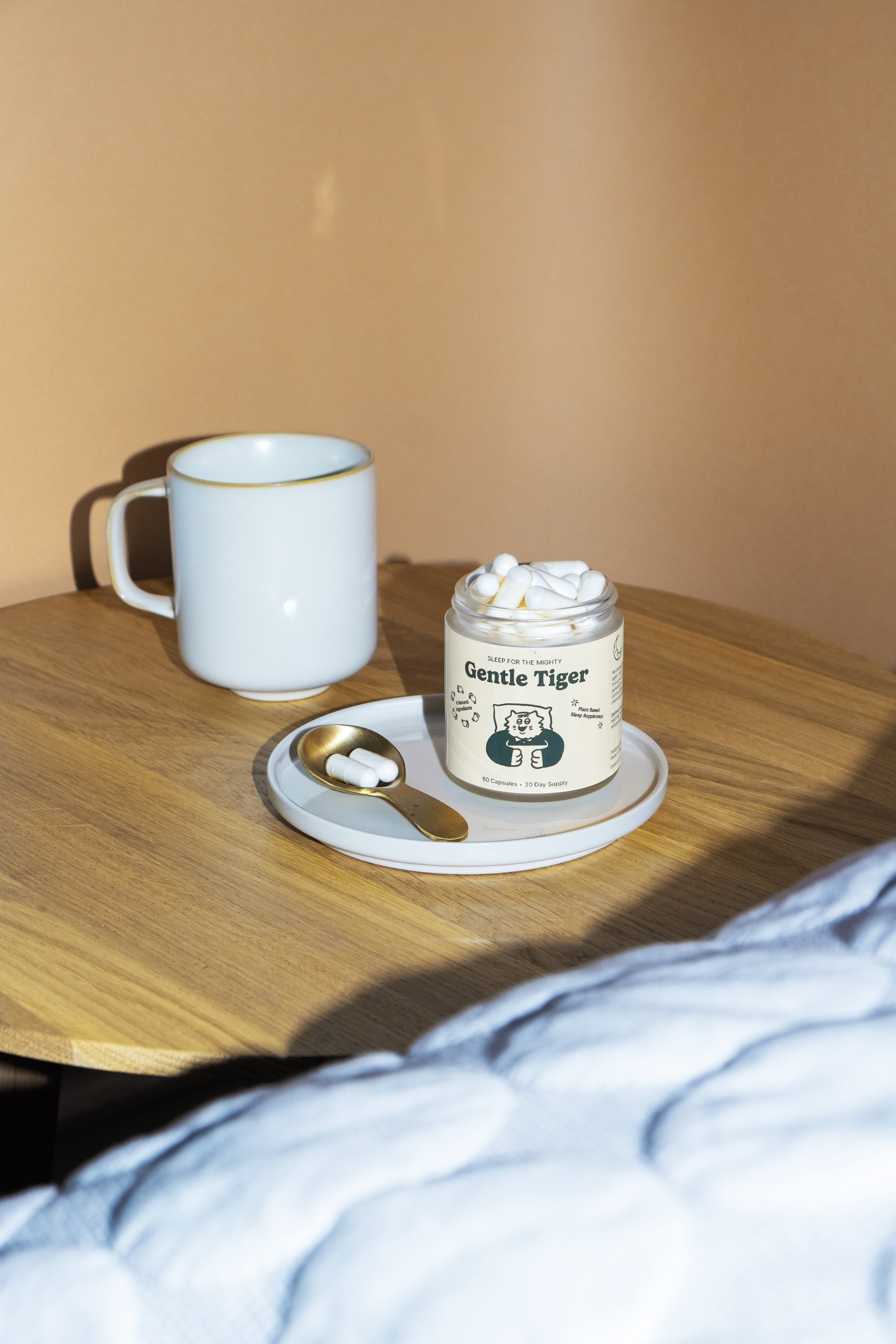
That's the gap Gentle Tiger fills. Poria Cocos in our formula extends time in REM and deep sleep. Spine date seed activates GABA pathways while lowering cortisol. Architecture work. A different layer than minerals.
Food first. Magnesium pill maybe. Plants for the deeper work.
Three layers, in order
There are three levers here, and the order matters. Food first. Most adults are short on magnesium because their diet is, and a few changes to what's on the plate cover most of the gap. Spinach, pumpkin seeds, almonds, dark chocolate, oats, black beans, avocados.
If you've cleaned up food and still want to supplement, magnesium glycinate (200 to 400 mg with dinner) is reasonable, well-tolerated, and supported by the modest evidence we have. Then 2 capsules of Gentle Tiger 30 to 60 minutes before bed for the architecture work that minerals can't reach. No known negative interactions between any of it.
- Food first: spinach, almonds, pumpkin seeds, dark chocolate, oats, black beans
- If you supplement: magnesium glycinate or citrate, 200 to 400 mg with dinner
- Gentle Tiger: 2 capsules, 30 to 60 minutes before bed
- No known negative interactions; consult your physician if on prescription medication
Common questions
Should I take magnesium or Gentle Tiger?
Start with food. Spinach, almonds, dark chocolate, black beans, oats. That covers most adults who think they have a magnesium problem. If your diet is solid and you still want baseline nervous system support, glycinate is fine and well-tolerated. Gentle Tiger works on a different layer entirely: the depth and quality of sleep, where plant pathways operate.
Which form of magnesium should I use?
For sleep contexts, magnesium glycinate is well-tolerated and commonly recommended. Citrate is also well-absorbed but more laxative. Avoid magnesium oxide; it's poorly absorbed. We don't have strong human RCT data comparing glycinate to L-threonate for sleep specifically, so claims that one is decisively better should be treated cautiously.
Is it safe to take both?
Yes. There are no known negative interactions between standard-dose magnesium supplementation and the six plants in Gentle Tiger. As with any supplement combination, consult your physician if you're on prescription medication or pregnant.
If I'm eating well and supplementing magnesium, do I still need a sleep supplement?
If your sleep is already excellent, no. If you're in a heavy training block, traveling frequently, or notice your deep sleep getting squeezed even after the food and the glycinate, magnesium alone usually won't get you there. Its sleep evidence is modest [4]. That's the gap Gentle Tiger is built for.
Peer-reviewed sources
Every claim on this page is backed by a PubMed-indexed study.
- [1]Abbasi B, Kimiagar M, Sadeghniiat K, Shirazi MM, Hedayati M, Rashidkhani B (2012). “The effect of magnesium supplementation on primary insomnia in elderly: A double-blind placebo-controlled clinical trial.” Journal of Research in Medical Sciences · PMID: 23853635
- [2]Boyle NB, Lawton C, Dye L (2017). “The Effects of Magnesium Supplementation on Subjective Anxiety and Stress — A Systematic Review.” Nutrients · PMID: 28445426
- [3]Rondanelli M, Opizzi A, Monteferrario F, Antoniello N, Manni R, Klersy C (2011). “The effect of melatonin, magnesium, and zinc on primary insomnia in long-term care facility residents in Italy.” Journal of the American Geriatrics Society · PMID: 21226679
- [4]Mah J, Pitre T (2021). “Oral magnesium supplementation for insomnia in older adults: a Systematic Review and Meta-Analysis.” BMC Complementary Medicine and Therapies · PMID: 33865376
Trade your melatonin for six plants
Why supraphysiologic melatonin is the wrong tool for nightly recovery sleep.
Read →The athlete recovery stack
How sleep stacks with protein, hydration, and cold therapy.
Read →The full ingredient science
Mechanism of action and key citations for each of the six plants.
Read →Stop dragging through morning training
Sleep gentle tonight. Train with a roar tomorrow.
Recovery Capsules
$44.0060 capsules · 30-day supply · 2 per night